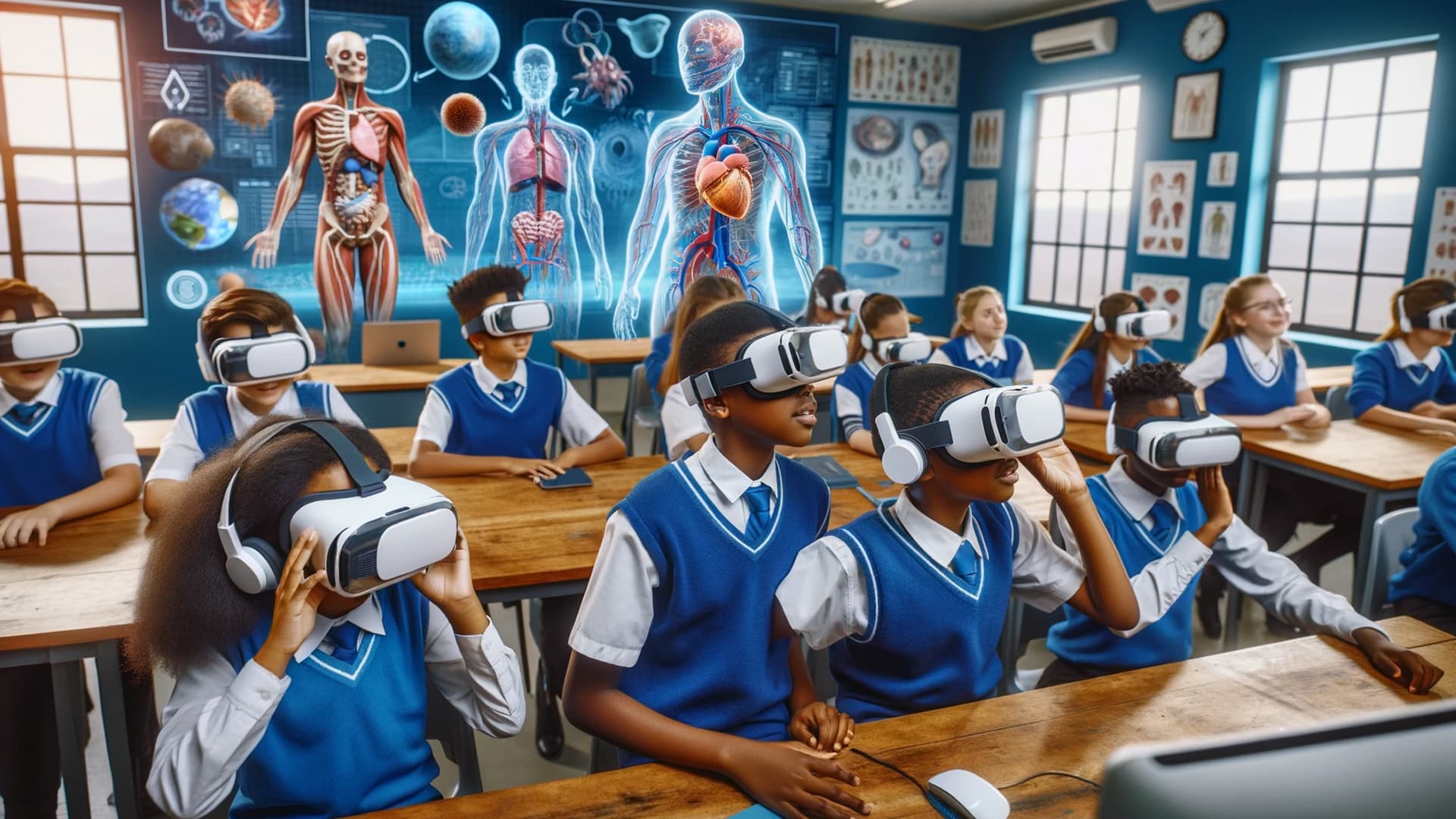
Virtual Reality in Our Schools: A Game-Changer for Education
Hey fellow students! You've probably heard about virtual reality (VR), right? Those cool goggles that transport you to different worlds. But have you ever thought about how VR...
Virtual Reality in Our Schools: A New Way of Learning
Hey fellow students! You've probably heard about virtual reality (VR) — those cool goggles that transport you to different worlds. But have you ever thought about how VR could transform our learning experiences right here in South African schools?
It might sound like science fiction, but VR could realistically revolutionize the way we learn.
1. Transforming Traditional Learning Spaces
Think about history or geography classes. They're interesting, but what if we could actually visit the places we're studying?
Imagine putting on a headset and suddenly walking through the Colosseum in Rome, hearing the crowds, or standing at the edge of the Grand Canyon.
VR removes the physical limits of the classroom and makes learning immersive, interactive, and far more engaging — especially for abstract topics.
2. Bringing Science and Math to Life
Subjects like science and math can feel intimidating when they're only on paper.
With VR, you could:
- Walk around a beating 3D human heart
- Explore planets and galaxies up close
- Manipulate geometric shapes in 3D space
This turns complex concepts into interactive experiences, making learning more intuitive and less overwhelming.
3. Experiencing History and Culture Firsthand
South Africa has a rich and diverse history.
With VR, students could:
- Witness historical events as immersive reenactments
- Explore cultural landmarks across the country
- Experience traditions and stories from different communities
This creates deeper understanding and appreciation for heritage and identity.
4. Language Learning Comes Alive
Learning a new language is often difficult in a classroom setting.
VR could simulate real-world environments like:
- A French market where you must speak French to buy items
- A street in Barcelona where you interact with locals in Spanish
This makes language learning natural, practical, and engaging.
5. Tailoring Education to Different Learning Styles
Everyone learns differently:
- Visual learners benefit from immersive 3D environments
- Hands-on learners can interact with objects and simulations
- Auditory learners can learn through guided narration and sound
VR supports all learning styles and can also help students who struggle in traditional systems by allowing self-paced learning.
6. Preparing for Future Careers
VR can give students real-world job experience before they even leave school.
For example:
- Engineering students can design and test virtual structures
- Medical students can practice virtual surgeries
- Science students can run virtual experiments safely
This helps students explore careers early and make more informed decisions.
7. Enhancing Teacher Training and Classroom Management
VR isn’t just for students — it also helps teachers.
Teachers can:
- Practice classroom management scenarios
- Test new teaching methods
- Simulate difficult classroom situations
This leads to improved teaching quality and better learning outcomes.
8. Bridging the Educational Divide
South Africa has unequal access to resources between urban and rural schools.
VR can help bridge this gap by:
- Bringing high-quality educational content to remote schools
- Providing equal access to immersive learning experiences
- Reducing dependence on physical infrastructure
9. Connecting Globally
VR can connect classrooms across the world.
Imagine:
- A biology class with students in Brazil
- A literature discussion with students in India
- Global collaboration between schools
This builds global awareness and cultural understanding.
10. Making Learning Fun and Engaging
Let’s be honest — school can sometimes feel repetitive.
VR turns lessons into experiences:
- Students become active participants
- Lessons feel like exploration rather than memorisation
- Engagement and retention improve naturally
Conclusion
The potential of virtual reality in education is enormous, especially in South Africa.
It’s not just about technology — it’s about transforming how we learn, understand, and experience the world.
There are challenges like access to devices and training, but the long-term benefits are clear:
VR could make education more engaging, inclusive, and powerful than ever before.
Author: Gerald Ferreira